
How Concrete Leveling Works: Why a Miramar Slab Sinks First
Every slab depends on the ground beneath it. When that ground weakens or shifts, the concrete loses its support, flexes and cracks, then drops, leaving trip edges at the seams and puddles where the slope once drained. A proper lift rebuilds support under the concrete and not only its height, so the work starts with the soil.
Miramar’s ground is sand over limestone. Soil maps list Margate fine sand, Pompano fine sand and Matlacha gravelly fine sand, and in the wettest months the water table reaches the surface in Margate fine sand. Loose fill compacts poorly, and moving water carries grains out from under a slab, so each season it settles a little further into the pocket.
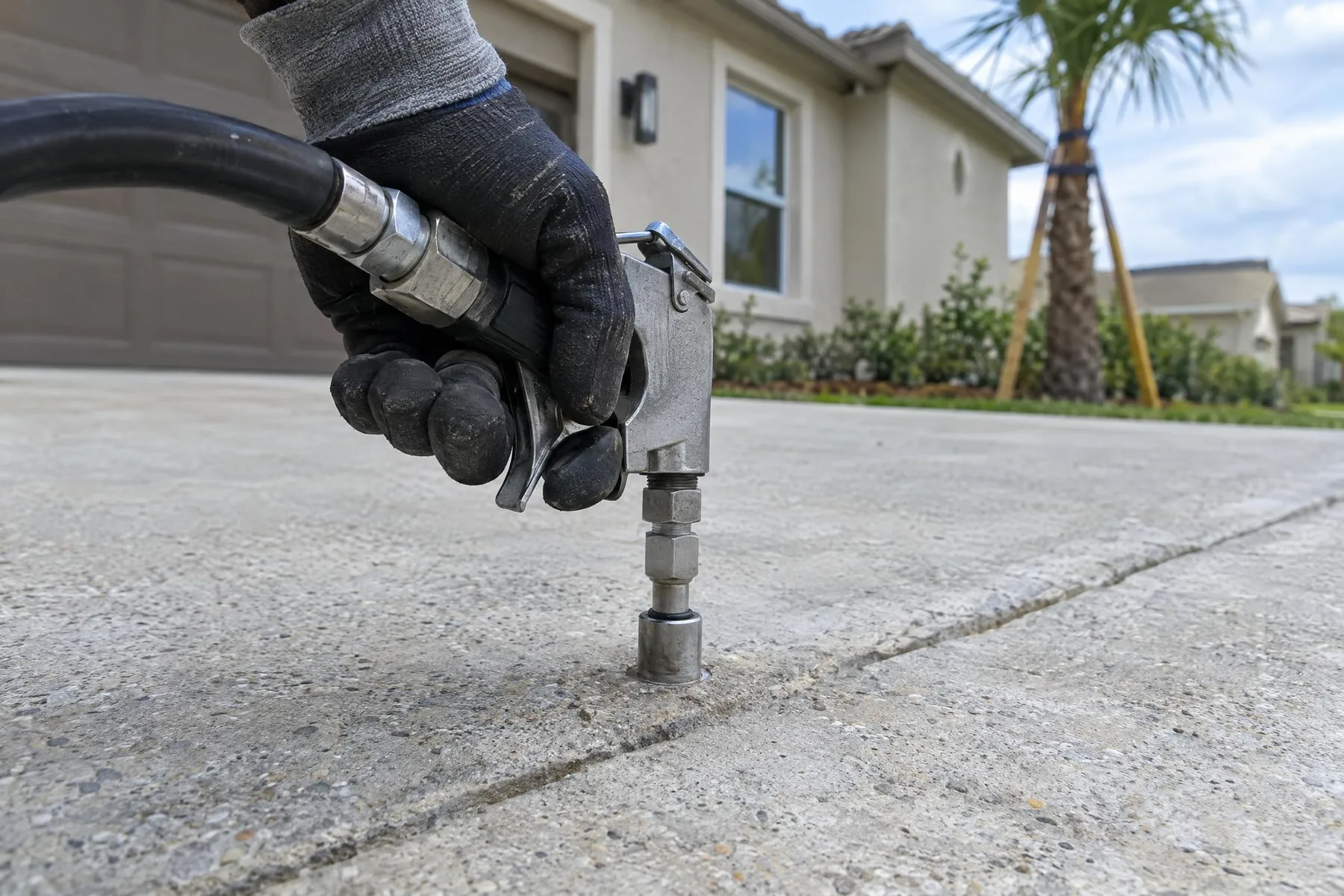
Nearly 70 percent of the year’s rain arrives between May 15 and October 15. Runoff slides under slab edges and carries sand off, so corners and joints sink first. A slab that sat flat in spring can look noticeably low by October, and the gap keeps widening until the void is packed. Crews begin where the slab dropped first, since that spot holds the deepest void, and the hole pattern follows from there. Voids at a driveway corner and along a pool deck edge need different hole layouts.
Setting adds to the picture. A slab poured over thin fill, or next to a canal or pool, sits in ground where water moves most freely, which means it settles earlier than a neighbor on firmer soil. Poor workmanship is not the cause. Soil shifted underneath it, and leveling replaces the support that soil used to provide. An early lift is the cheapest, because the void is still small and the foam volume stays low.